Texas business owners · The questions worth asking
Why Accreditation
matters in 2026.
The record. The standards. Who answers when the promise is tested.
I’m Michael Azcona, Business Development Representative at BBB Heart of Texas. This is my independent guide to the questions behind a business owner’s first conversation.
Include your company name and city when booking.
Search, visibility & trust
Make your business easier to find and verify.
Three guides for the questions business owners are asking now.
Search & Trust
How your website, public profiles, and accurate business information help a customer verify you.
Read guideIs SEO Dead?
What still matters in search, what AI changes, and where trust fits into the customer’s decision.
Read guideTrust Story Checklist
Check the identity, proof, policies, and service facts that tell your business’s public story.
Read guideThe real questions
Start with the real-life decision.
Why did BBB begin, and why does it still matter in 2026?
BBB’s roots go back to 1912 and the push for truthful advertising. The tools have changed. The human question has not: can I trust what this business is telling me? Today the decision may start with a map, a social post, a website, or an AI answer. A buyer still needs to connect a claim to a real business and a record they can inspect.
If buyers and businesses already had complete information, trusted each other, and kept every promise, why would BBB be needed? A marketplace needs places where business identity and claims can be inspected. That is the work behind the history.
More than a century. The same question: who will keep the promise?
Check the source: BBB: More than a century of marketplace trust
Link to this answerTrust and neutrality
BBB · Verbatim excerpt
We do not take sides, and we cannot force a business to act.Link to this section
“We’re licensed to pull permits.” What credential does that actually prove?
Ask for the credential’s name, the issuing agency, and the work it covers. A building permit, contractor registration, professional trade license, inspection, and BBB Accreditation answer different questions.
Austin provides a useful example: a homeowner can register as a general contractor and activate a building permit. Texas does not require a state general contractor license. Austin’s electrical, mechanical, and plumbing trade work has separate rules, including a limited qualified-homeowner route. That Austin example is not a rule for every Texas city.
- Who is listed on the permit?
- Who will actually perform the work?
- Which trade license is required, and is it current?
- Who schedules inspections and answers for corrections?
Permission to activate a permit is not proof of every skill the project needs.
Check the source: Austin: Contractor registration · Austin: Homeowner permits
Link to this answerWhat is underneath the fence, slab, wiring, or gate?
A fence post near a buried line. A slab poured over a sprinkler system. Wiring hidden throughout an occupied home. A roughly 1,000-pound electric gate in an illustrative scenario, moving beside people. These are examples of decisions a customer may never see until something fails. Who checked first? Who chose the materials? Who will answer afterward?
Some specified power-limited and communications circuits are exempt from the Texas state electrician license. That does not make all security or low-voltage work unregulated. DPS separately regulates burglar-alarm installation and alarm-specific pre-wiring. Fire-alarm work has a separate State Fire Marshal licensing system. Ask about the actual system, not just the label “low voltage.”
DPS says a standalone gate opener and convenience controls can be outside private-security licensing when no other regulated activity is performed. Alarm connections or monitoring entry and exit change that boundary. Adding a non-exempt mains circuit is a different electrical job. Local rules and gate safety requirements still matter. Ask about entrapment protection, inspection, and the installer’s responsibility.
Before the first shovel hits dirt, choose a visible BBB Accredited Business whose standards, record, and willingness to answer for the work you can check, because accountability should start before impact.
Check the source: TDLR: Electrician licensing exemptions · Texas DPS: Alarm installation and pre-wiring · Texas State Fire Marshal: Fire industry licensing · Texas DPS: Gate operators and garage door openers · UL Solutions: Access control and gate safety
Link to this answer“We’ll dry it out and work around the mold.” Who owns the next step?
Water extraction and drying do not, by themselves, tell you whether mold assessment or remediation has been completed. In Texas, TDLR regulates mold assessors and remediators, with specific exemptions. The right scope depends on the job. A general service label cannot settle that question.
- What caused the water, and has that source been corrected?
- Which materials are wet or damaged, including hidden areas?
- Who evaluates suspected or visible mold?
- Who performs remediation, and what license or specific exemption applies?
- What written scope, completion evidence, and handoff will I receive?
These are questions to put to the qualified people handling the property. “Restoration,” “mitigation,” “handyman,” and “general contractor” can cover very different work. Ask who accepts responsibility for each part.
Check the source: TDLR: Mold assessors and remediators FAQ
Link to this answerIf the job goes wrong, can you find the business that took responsibility?
Start with the name on the contract. Compare it with the business’s website, BBB record, contact details, and applicable license. A similar name is not enough. Ask who owns or manages the work and how a customer reaches someone who can act.
A traceable business matters before a problem becomes a headline. “Were you number 56?” is my way of asking why a buyer should wait for a pattern of harm before checking. Texas regulators investigate unlicensed trade work. BBB’s work is public information and marketplace accountability; it does not replace government enforcement.
For formal legal papers, an entity’s registered agent and registered office have a specific role. A BBB contact address is not automatically an address for legal service. Public business identity also does not mean publishing an owner’s private home.
Find the company. Find the promise. Find who answers.
Check the source: Texas Secretary of State: Registered agents · TDLR: Complaints and enforcement
Link to this answerWhat does it cost to pay a second contractor to rescue the first job?
Imagine a $250,000 dream pool financed against the home. A large deposit is paid, a hole is left in the yard, and weeks become months. Or a kitchen, walk-in shower, cabinets, and appliances become an unfinished project. The next contractor has to assess what happened, correct it, and finish the work. A rescue is not automatically cheaper. These are illustrations, not allegations about a named company.
Now compare a business with a clear identity and current record. Suppose you can check a 15-year Accreditation history, recent project photos that match across its pages, and a local Little League sponsorship. That is a hypothetical set of signals to investigate. Read the details; a banner alone cannot promise the result.
For a large home project or a $200,000 business commitment, examine the written scope, milestones, change terms, applicable credentials, insurance evidence, and contact path. BBB Accreditation does not by itself establish the insurance coverage a particular project needs.
We are not the end all. Ok. But what you do privately needs to be shown publicly! Do your community a favor and get accredited
Check the source: BBB Accreditation Standards
Link to this answerIn an emergency, what is the shortest useful verification path?
Right information at the right time.
A roof leaks into the attic. A pipe bursts inside a wall. A window or door will not close. You need help nearby, but you still need to know who is coming.
- Find a nearby business that handles the actual problem.
- Open its BBB profile. Match the identity and check current Accreditation, record, and any relevant licensing information.
- Confirm the applicable trade credential with its issuing agency when needed.
- Visit the company website. Compare the services and contact facts.
- Call about availability, scope, charges, and who performs the work.
A useful public record reduces the work of making that call. The order above is a buyer scenario; search placement and the completeness of any one profile vary.
Check the source: BBB Business Profile checklist
Link to this answerAccreditation
What is visible, approved, and maintained?
What can a customer actually check in a BBB Business Profile?
Look for the business name, address or service area, phone, website, categories, start date, time in business, ownership or management where published, and Accreditation status. Match those facts to the company you are hiring, including any similarly named businesses.
Some profile information comes from businesses and other third parties. BBB’s profile disclaimer does not promise that every field is independently verified. Trade credentials should be checked with the issuing agency. The value is in a public record a customer can inspect and compare.
Check the source: BBB Business Profile checklist
Link to this answerWhat does Accreditation add to an ordinary listing?
A business can have a BBB profile without being Accredited. Accreditation is a separate reviewed commitment to meet and maintain BBB’s standards. It gives customers a current status to check through BBB and lets approved businesses use the licensed Seal under BBB’s rules.
When an owner says “we keep our promises,” the next question is whether that promise is visible, supported, and maintained when something gets difficult.
Check the source: BBB: Questions about BBB · BBB Accreditation Standards
Link to this answerWhat responsibilities continue after approval?
Meet and maintain all eight Standards for Trust:
- Build Trust
- Advertise Honestly
- Tell the Truth
- Be Transparent
- Honor Promises
- Be Responsive
- Safeguard Privacy
- Embody Integrity
Check the source: BBB Accreditation Standards
Link to this answerWhat stands behind the directory?
What directory does all of this?
BBB combines public business information, separately reviewed Accreditation, advertising standards, alerts, Scam Tracker, and local human assistance. It is a nonprofit network connected to local marketplaces, across industries and business sizes. My challenge is about that combination, not a claim that no other organization provides any of those services.
A neighborhood recommendation, a news story, a trade credential, and a legal service each answer part of the buyer’s question. BBB brings a wider marketplace record and standards commitment into the conversation. Relevant identity, ownership history, licensing, and advertising deserve attention together.
- Public resources: profiles, scam warnings, and consumer education.
- Accredited Business tools: current status, authorized Seal use, quote requests, profile tools, and locally offered benefits.
- Optional services: additional advertising, website, and SEO services have their own scope and terms.
- Separate Foundation work: education, mentoring, and community programs have their own funding and eligibility.
From landscapers to skyscrapers
Check the source: BBB: More than a century of marketplace trust · BBB Heart of Texas programs and events
Link to this answerIs this only for small contractors?
No. The record reaches across industries and sizes. These specific BBB profiles displayed Accredited status when checked for this guide on October 8, 2026:
| Business | Profile location |
|---|---|
| Dell Inc | Round Rock, Texas |
| Neiman Marcus Company | Dallas, Texas |
| Rent-A-Center, Inc. | Plano, Texas |
| Credit Union of Texas | Allen, Texas |
| RPM Living | Austin, Texas |
| Amazon.com | Seattle, Washington |
| Lowe’s Home Centers, LLC | Mooresville, North Carolina |
| Constant Contact, Inc. | North Waltham, Massachusetts |
| Visa Inc. | Foster City, California |
| Hearth | San Francisco, California |
I personally worked with RPM Living. These examples are links to inspect, not an endorsement of each project or a claim about every similarly named branch. Status can change. Read the exact profile for the company and location involved. Hearth is the contractor software and financing platform, not a similarly named home-services business.
Link to this answer“Customers don’t call saying they found us on BBB.” What about the people who never call?
Owners tell me: “Customers don’t call me and say I found you on the BBB.” “I never had a customer not work with me because I was not accredited.” “We don’t have the marketing budget, besides, we don’t get calls asking if we are accredited.” Those are reported objections. They do not reveal every decision a buyer makes in private.
Imagine choosing where to spend $100 on dinner with your family. If the photos and menu do not convince you, do you call the restaurant to explain why you went elsewhere? Usually you choose another place. Now make the decision a $65,000 roof. A prepared homeowner may research before ever contacting the roofer. The business cannot count every person who quietly ruled it out.
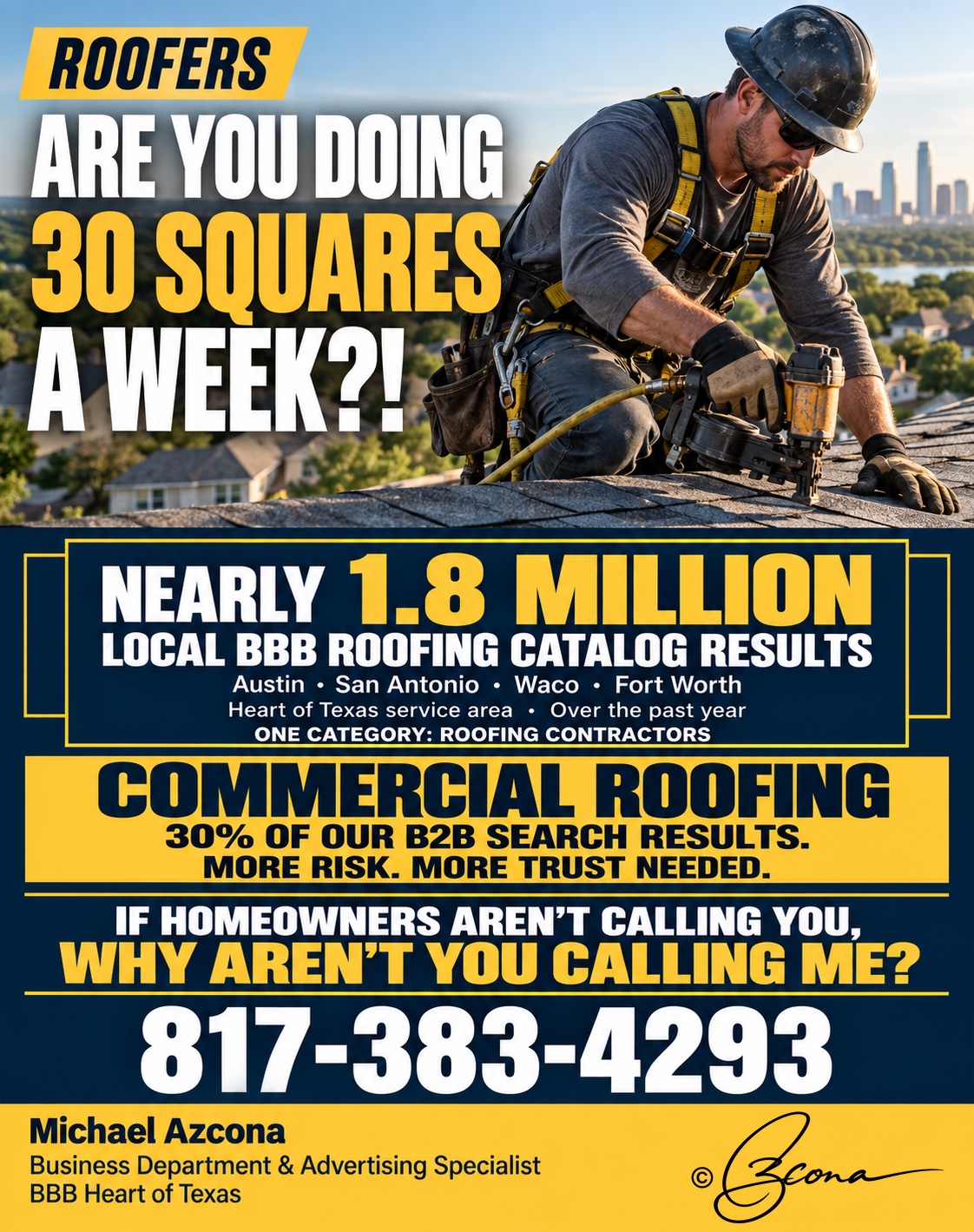
The approved roofing example I shared in September 2026 reports nearly 1.8 million local BBB catalog results over the preceding year for Roofing Contractors alone, one Type of Business in the Heart of Texas service area. Other roofing categories have their own data. These are catalog results, not unique people, calls, or completed jobs, and categories should not be added together without checking overlap.
That figure is attributed to my supplied local material, not an independently audited audience total. View the supplied roofing graphic. The useful owner question is whether the customer who does inspect your record can find accurate, visible proof.
Marketing can help you be found, BBB can help you be chosen.
Link to this answerWhat happens when a customer checks again after booking?
Imagine someone booking tree trimming and stump grinding because they want the work soon. The appointment approaches, the quote is higher than expected, and a quiet question appears: “Did I make the right decision, is this the best choice for me?” That buyer may search again.
Do you want to be hard to find, or confused with a business with a similar name? Or easy to find, easy to click through, and easy to verify? A clear identity and current BBB record give the person something beyond your own word to examine.
Legacies matter.
BBB’s history reaches back to 1912. More than a century of marketplace work is context for the standards, while the actual business still has to keep its promises. The tree job is an illustration. Accreditation is a checkable commitment, not a promise that every job will go perfectly.
Check the source: BBB: More than a century of marketplace trust
Link to this answerReviews & disputes
BBB source excerpts.
How are BBB reviews different?
BBB · Verbatim excerpt
BBB confirms that a marketplace interaction took place between the reviewer and the businessLink to this section
Are BBB customer reviews the same as BBB complaints?
BBB · Verbatim excerpt
No, reviews and complaints are different.
BBB · Verbatim excerpt
Customer reviews are not used in the letter-grade calculation.Link to this section
Complaint Process
When you file a complaint
Complaint Acceptance Guidelines
BBB · Verbatim excerpt
The complaint relates to a marketplace issue.
BBB · Verbatim excerpt
Marketplace issues do not include the following:
BBB · Verbatim excerpt
Employer/employee disputes.Link to this section
Dispute Resolution
BBB · Verbatim excerpt
Your BBB may offer three major dispute resolution options.
BBB · Verbatim excerpt
Mediators don't decide who is right or wrong.
Arbitration
BBB · Verbatim excerpt
Arbitration is a process in which two or more persons agree to let an impartial person or panel decide their dispute.Link to this section
Visibility & tools
Help a customer find, understand, and contact you.
“Nobody checks BBB anymore.” How do you know?
When I ask homeowners whether they check BBB before hiring, roughly nine in ten in my conversations say yes. That is my anecdotal experience, not a survey or a market percentage. But it is a reason to ask the question instead of assuming the answer.
They check the BBB, they just might not write the ‘check’ to you.
If someone examines your record and chooses another business, they may never tell you. Would you prefer that a buyer not verify before committing, or that they find the right information about your business? Look at the record yourself. That is something you can act on today.
Link to this answer“Google beat you and took over.” Are Google and BBB doing the same job?
We don’t compete with Google, we support your SEO.
Google can introduce a nearby business. A BBB record gives a customer another route to examine its identity, standards commitment, service information. The company website should then explain the actual work and make the next contact clear. Discovery and verification fit into the same customer journey.
Keep the public facts consistent, publish useful answers, and make your source links readable and crawlable. This is practical support for a business’s online presence and a buyer’s evaluation. It does not require treating the two organizations as interchangeable.
Check the source: Google: Helpful, reliable, people-first content · Google: AI features and your website
Link to this answerNAP, SEO, AIO/GEO, E-E-A-T, SXO: what do these mean in plain English?
- NAP
- Name, address, and phone. Does the same real business appear across its records?
- SEO
- Search engine optimization. Can a search engine find and understand useful pages about the work?
- AIO/GEO
- Working terms around AI and generative discovery. Can people and systems understand accurate, well-sourced information?
- E-E-A-T
- Experience, expertise, authoritativeness, and trustworthiness. Google uses these ideas in evaluating content quality; they are not a BBB score.
- SXO
- Search experience optimization. Does the journey from search to the page and the next action make sense for a person?
Be found. Be understood. Be verified. Be chosen.
A BBB record can support the verification step. Your own website must still explain your qualifications and work. Google says the usual search foundations apply to its AI features. Neither Accreditation nor a public profile promises a ranking, an AI citation, or a particular return.
Check the source: Google: Helpful, reliable, people-first content · Google: AI features and your website
Link to this answerWhich tools help a customer move from checking to contacting?
- Accredited-only search: an owner needs current Accredited status to be included when that filter is applied.
- Get a Quote: a customer can request service details through a participating Accredited Business profile.
- A useful profile: current contact facts, service area, products, social links, photos, videos, and policies.
- “Accredited Since”: a visible date to inspect alongside current status.
- Authorized Seal and decals: a licensed signal on approved business materials, with current status verified through BBB.
For Get a Quote, if no response arrives within 24 hours and the consumer opted for multiple quotes, BBB says the request can be forwarded to nearby Accredited Businesses in the same industry. Participation and the notification route must be set up. It is a tool to respond to, not a promise of a job.
Check the source: BBB Get a Quote program FAQ · BBB Business Profile checklist
Link to this answerWhat about profile reports, an SEO audit, and advertising?
In my work with Heart of Texas businesses, I discuss locally offered public-profile activity reports and SEO audits. Ask me what is currently included for your business, what needs activation, and what is a separate service. Do not infer the same package from a benefit offered by another BBB.
Use activity reports to see observable interactions, then compare them with your own inquiries and booking records. BBB hosts a third-party public record and determines Accreditation status; business-provided photos and details still need to be accurate.
BBB’s renewal page reports more than 170 million BBB.org site visits in 2025. That is sitewide reach, not the audience of your individual profile or a number of leads promised to your company. Optional digital advertising, website, and SEO services have their own scope.
Check the source: BBB Accreditation renewal: 2025 site visits · BBB Heart of Texas programs and events
Link to this answerWhat should I check before I book with Michael?
- Prove it. Gather your real company identity, service facts, credentials, policies, and authentic examples of work.
- Verify it. Compare your website and public profiles. Check current BBB status and required trade licenses.
- Publish it. Correct stale information and make the approved facts easy to inspect.
- Review it. Revisit the public record when business facts change.
What you say face to face and what a customer finds online should tell the same truthful story. Bring your company name, city, and website to our conversation. We can look at the public record and discuss the appropriate next step.
Book with Michael or call 817-383-4293.
Link to this answerCommunity & dues
Local accountability and a wider mission.
Who sets dues, and why do they vary?
An annual investment supports an ongoing standards commitment and marketplace work. The current dues depend on business details and local terms; there is no single statewide price to quote from this guide.
From my firsthand Heart of Texas experience, local Accredited business leaders on the Board set a market-sensitive dues schedule. Business size matters, and metro and less dense markets can differ. Ask me for the current dues sheet for your business and city. We can review the amount and terms together before you decide.
Check the source: BBB Accreditation Standards
Link to this answerCan a business owner get involved in local governance?
Yes, ask about the current route to Board involvement. From my firsthand experience, our local Board holds an annual meeting to vote in new members, and prospects are interviewed and vetted further by peers. Those are local practices I can discuss with you.
A local marketplace benefits from people who understand the businesses and customers in it. Bring your interest and questions. Current qualifications, openings, and the selection process should come from the local organization; this page is not a promise of a Board seat or a universal rule for every BBB.
Link to this answerIf much of BBB’s help is free, who supports it?
Accredited Business dues support BBB’s marketplace mission, including free public business information. The work reaches people who never pay BBB: consumers checking a company or reporting a scam.
That is wider than an individual business’s tools. Public information, customer education, alerts, and Scam Tracker have community value. The separate Foundation also has its own partners and funding streams. A Foundation program is not automatically a benefit purchased with Accreditation dues.
Check the source: BBB: Questions about BBB · Heart of Texas complaint process · Heart of Texas Foundation for Better Business
Link to this answerWhat does the work do beyond one business profile?
Scam Tracker gives people a free way to report and research scam experiences. BBB Institute estimated that it helped consumers avoid nearly $38.9 million in potential losses in 2025. That is an estimated platform impact, not a refund total or a return assigned to an individual business’s dues.
Learning, mentoring, and ethical business recognition add other ways to participate. A stronger marketplace needs information before harm.
Check the source: BBB Institute: Scam Tracker impact in 2025
Link to this answerWhat is BBB doing for students and younger adults?
Heart of Texas announced a Fall 2026 Texas State University student ambassador to connect students with business resources, smart consumer choices, and scam awareness. That is a local example. Across Texas, BBB serving North Central Texas’s Education Foundation has a Student Video Contest and the BBB/Louis J. Rodriguez Ethics Scholarship. Those are North Central Texas programs with their own eligibility, not a claim that Heart of Texas currently offers the same scholarship.
Young adults need to learn how to check a job offer, an online shop, a business promise, and a suspicious message before a costly mistake. Use the current program pages for dates and eligibility. Awareness and a place to report should start early.
Check the source: Heart of Texas: Fall 2026 student ambassador announcement · BBB North Central Texas Education Foundation · BBB Institute Scam Tracker Risk Report
Link to this answerWhat about women’s events, networking, and free learning?
The separate Heart of Texas Foundation for Better Business publishes She Means Business, Power of Better Business, Ignite Essentials, Blueprint, and a Small Business Growth Summit. Its work includes education, mentoring, and opportunities to connect with other entrepreneurs. Local offerings have also included Coffee and Connections and Spanish-language Almuerza y Aprenda. Check the current calendar for availability and terms.
The public Heart of Texas Business Knowledge Library offers recorded business-focused webinars. Other BBB resources address cybersecurity and AI. Some live learning sessions are restricted to Accredited Businesses, and some events charge. “Learning opportunity” is not the same as “every session free to everyone.”
Find the topic that helps your business now, then confirm the audience, registration, price, and location.
Check the source: Heart of Texas Foundation for Better Business · Heart of Texas Business Knowledge Library · BBB Heart of Texas programs and events
Link to this answerDo welcome announcements and awards come with Accreditation?
I have seen welcome announcements, open houses, fall celebrations, awards events, and media conversations help businesses become visible in their communities. Opportunities vary by local BBB and market. They are not a guaranteed television interview, article, or award.
Torch and Spark are separate recognition programs with their own rules. Heart of Texas’s Torch criteria say Accreditation is not required. Check current eligibility and deadlines. Share your real work and ethical practices; a recognition opportunity should reflect them.
Check the source: Heart of Texas Torch Awards criteria · BBB Heart of Texas programs and events
Link to this answer“Isn’t BBB only for old people?” Why does this work matter across ages?
The FTC reported more than $3 billion in older adults’ reported fraud losses in 2025. Young adults face serious risk too: BBB’s 2024 Scam Tracker Risk Report identified employment scams as the riskiest category for ages 18–34. Online shopping and messages on social platforms also deserve attention. No age group has a monopoly on needing to check before committing.
Embarrassment or not knowing where to turn can keep someone silent. Teach people early how to verify, preserve the facts, and find the appropriate help. The point is not to stereotype an age group. It is to make useful information available when someone needs it.
Check the source: FTC: Top scams affecting older adults, May 2026 · BBB: 2024 Scam Tracker Risk Report findings
Link to this answerCheck the sources
Inspect the standards, guidance, and public records behind the answers.
Official sources are linked beside the answers and collected here so you can inspect the underlying information.
Local experience and illustrations are identified as such. Public facts and named business profiles were checked October 8, 2026; status and program terms can change. For current Accreditation status, read the exact business’s BBB profile.
BBB standards, profiles & dispute handling
- BBB: More than a century of marketplace trust
- BBB: Questions about BBB
- BBB Accreditation Standards
- BBB Customer Reviews FAQ
- Heart of Texas complaint process
- BBB Complaint Acceptance Guidelines
- BBB Mediation Rules and Guide
- BBB Rules of Conditionally Binding Arbitration
- BBB Business Profile checklist
- BBB Get a Quote program FAQ
- BBB Accreditation renewal: 2025 site visits
Search & AI guidance
Texas credentials & project responsibilities
- Austin: Contractor registration
- Austin: Homeowner permits
- TDLR: Electrician licensing exemptions
- Texas DPS: Alarm installation and pre-wiring
- Texas State Fire Marshal: Fire industry licensing
- Texas DPS: Gate operators and garage door openers
- UL Solutions: Access control and gate safety
- TDLR: Mold assessors and remediators FAQ
- Texas Secretary of State: Registered agents
- TDLR: Complaints and enforcement
Community, education & consumer research
- Heart of Texas Foundation for Better Business
- BBB Heart of Texas programs and events
- Heart of Texas Torch Awards criteria
- BBB North Central Texas Education Foundation
- Heart of Texas Business Knowledge Library
- BBB Institute: Scam Tracker impact in 2025
- FTC: Top scams affecting older adults, May 2026
- BBB Institute Scam Tracker Risk Report
- BBB: 2024 Scam Tracker Risk Report findings
- Heart of Texas: Fall 2026 student ambassador announcement
Named business profile examples
Read the exact location and current status. An example is not an endorsement.
The next conversation
Bring the real question.
Bring your company name, city, and website. Let’s inspect what a customer sees and discuss your next step.